
National Footprint
Two complementary public inventories show where ALPR systems are documented—without pretending deployment records and camera counts are the same thing.
There is no complete public national registry of automated license-plate readers. Flockwatch therefore uses two inventories with different units.
EFF Atlas of Surveillance
The downloaded Atlas snapshot contains 15,071 surveillance-technology records. Filtering Technology == Automated License Plate Readers yields 4,084 records across the fifty states and District of Columbia. Each row documents an agency or jurisdiction's adoption based on a linked public source.
An Atlas row is not a camera. A statewide agency row may represent a large fleet; a local row may represent one pilot. The data are best used to study documented adoption, vendor naming, and geographic coverage—not hardware totals.
Flock Safety appears in 2,629 ALPR rows (64.4%). That is strong representation in the Atlas corpus, not a commercial market-share estimate.
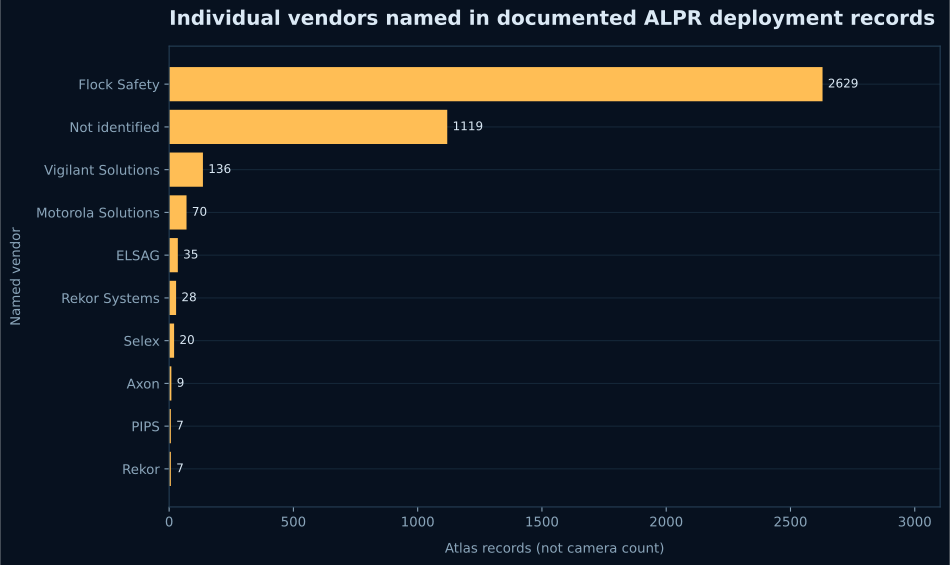 Vendor-field records, not installed devices. Unknown and multi-vendor records remain.
Public camera mapping
Eyes Off Indiana publishes a national state-ranking file derived from public OpenStreetMap observations and 2024 Census population denominators. It contains 113,963 publicly mapped cameras across fifty states, or 33.6 cameras per 100,000 residents.
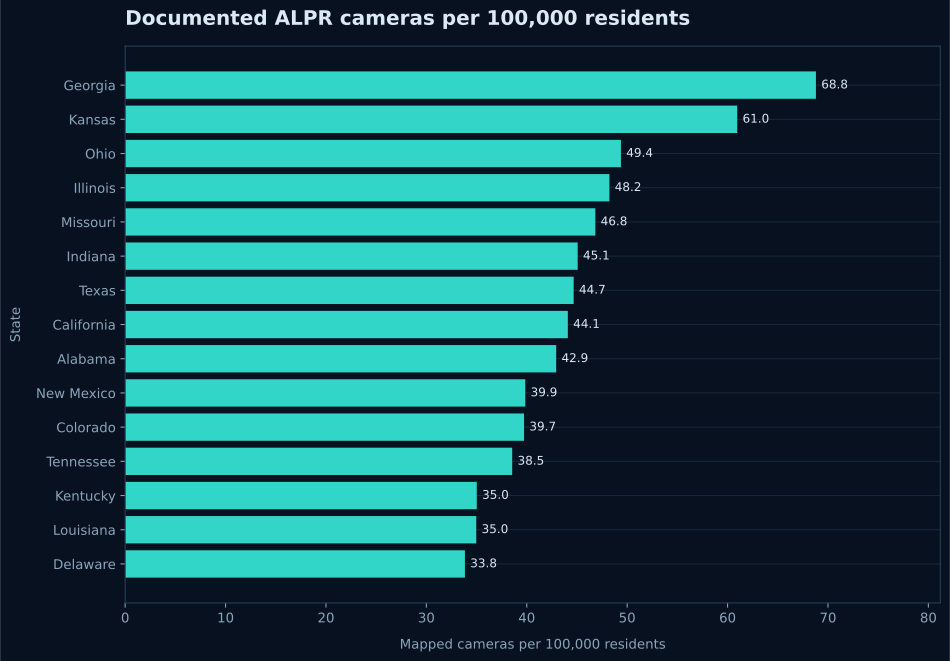 Publicly mapped camera density. Differences may reflect both deployment and documentation intensity.
This is a lower-bound census. Cameras may be absent because nobody mapped them, because coordinates were unavailable, or because the source's classification rules differ from agency records. Conversely, stale map objects may lag removals.
What public transparency portals add
Agency portals can expose camera counts and recent detection volumes without exposing individual vehicle movements. In the Indiana portal sample used here:
| Unit | Publicly reported value |
|---|---|
| Agencies | 18 |
| Cameras | 189 |
| 30-day detections | 3,920,631 |
| Detections per camera per day | 691.5 |
The sample is not nationally representative. It does show how quickly a relatively small group of cameras can create millions of records.
Why this matters
Scale changes the character of a technology. A single roadside observation is ephemeral. A dense, networked, historically searchable collection can reveal routes, associations, worship, medical visits, protest attendance, and recurring patterns. The legal system has not yet supplied a uniform rule for when that aggregation becomes a Fourth Amendment search.